
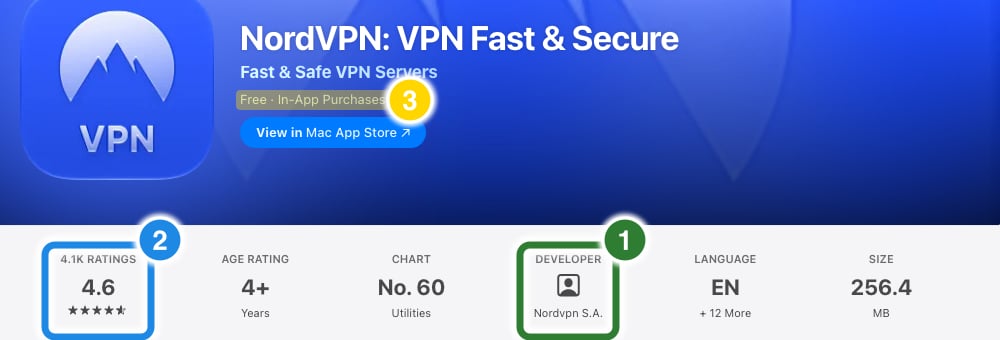
Before you install a VPN on your phone, give the store page thirty seconds. Three small details in this screenshot tell you more than any banner.
Number 1, in green, is the developer name: Nordvpn S.A. App stores carry plenty of VPN apps with similar names and similar logos, and some have nothing to do with the company you think you're getting. The check is simple. The developer name should match the company on the official website. On the Israeli Google Play store, NordVPN's app is listed under Nord Security, the parent company, which is fine.
Number 2, in blue, is the rating: 4.6 from about 4,100 ratings on Apple's Israeli store. On Google Play it's the same 4.6, this time from 1.39 million reviews and more than 100 million downloads. I don't buy an app because of its stars, but a VPN app with 40 ratings and an unknown developer is a reason to stop.
Number 3, in yellow, says "Free · In-App Purchases". The download is free, using it isn't. Without a subscription you can open the app and not much more. That's not a bug, it's the business model.
What Apple's label tells you, and what it doesn't
Further down the same page there's a section most people scroll past: App Privacy. It's a declaration filled in by the developer, using Apple's categories.
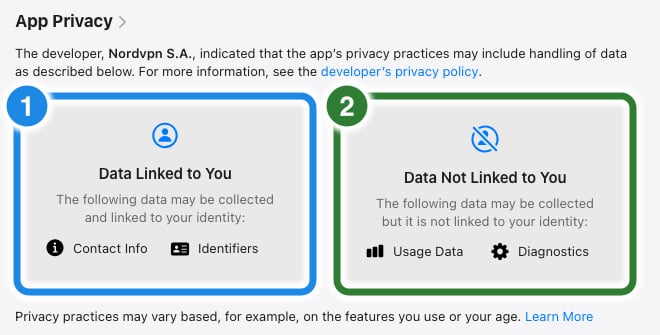
In the blue frame, number 1: the data linked to your identity is contact info and identifiers. In practice that means your email and account, which any paid service needs to know who paid. In the green frame, number 2: usage and diagnostics data, which according to the declaration isn't linked to you. What's missing from the list is just as interesting. No browsing history, and no location.
Remember what this label is, though. It's a self-declaration, and Apple notes that practices can vary depending on the features you use. So I look for something next to it: an independent no-logs audit. For NordVPN that's Deloitte's sixth assessment, from late 2025. Google Play has its own version, called "Data safety", where NordVPN states it doesn't share data with third parties.
Four minutes of setup
The process is almost identical on iPhone and Android. Download the official app, sign in, and on the first connection the phone asks you to approve adding a VPN configuration. On an iPhone that means typing your device passcode. On Android a connection request pops up. Both screens look a little alarming, and both are completely normal. You approve once and never see them again.
Then tap quick connect or pick a country. A small VPN icon appears in the status bar. Want to be sure? Search Google for "what is my IP" and check that the country shown is the one you picked.
If you're abroad and need an Israeli address, for a bank website or a TV channel, look for Israel in the country list. All four providers we compare have an Israeli location. NordVPN, according to its official site, has 14 servers there. To get your normal address back, just disconnect.
Battery, banking apps and the other annoying bits
A VPN uses a little more battery and a little more data, because of the encryption and the connection that stays open. On most phones you won't notice. If you do, switch it on only when you need it: on public Wi-Fi, or abroad.
Three things can be genuinely irritating. Some banking and streaming apps don't like VPN addresses, so you switch servers or disconnect for a moment. On Android, some manufacturers kill background apps to save battery, and the VPN drops when the screen is off; the fix is to exclude the VPN app from battery optimisation in settings. And if you suddenly have no internet at all, Apple's own support site notes that VPN apps can block connections. Disconnect the VPN and test again.
What it costs in shekels
Here's something that particularly bugs me on an Israeli site: almost every VPN provider shows us prices in dollars. I converted them at the Bank of Israel representative rate of November 26, 2026: ₪3.334 to the dollar.
NordVPN, my pick for phones, costs about ₪269 ($80.73) for 27 months at Black Friday prices checked on 26 November 2026, roughly ₪9.97 a month ($2.99), with up to 10 devices on one account: your phone, laptop and tablet, with room left for the rest of the household. I choose it for the combination we saw above: an identifiable developer, high ratings on both stores, a relatively clean privacy label and an independent audit that keeps being repeated. The low price is for the first term only. Renewal is about ₪464 a year ($139.08), and it's printed on NordVPN's pricing page, not hidden.
Surfshark is cheaper to start with, about ₪179 ($53.73) for 27 months, and doesn't cap devices, which suits a big family. Proton VPN is the only one of the four with a genuinely free plan, for one device, without ads. And ExpressVPN is the only one that bills Israeli visitors in shekels: ₪238 for 28 months.
Why does that matter? Because on a dollar payment most credit card companies add a foreign-currency transaction fee, 2.9% in Isracard Direct's tariff and 3% at First International Bank. One more small thing: if you buy the subscription inside the iPhone app, you pay Apple, in shekels, at the store's price list, which isn't always the same as the deal on the website. Compare the two before you tap.
All four providers offer 30 days to get your money back. On a phone that matters more than usual, because only after a week of real use do you know whether your banking app gets along with the VPN and whether the battery lasts a full day.
Sources
The app pages: apps.apple.com/il/app/nordvpn-vpn-fast-secure/id905953485 and https://play.google.com/store/apps/details?id=com.nordvpn.android
VPN settings according to Apple and Google: support.apple.com/en-us/102281 support.google.com/android/answer/9089766
Prices and servers from the official sites: nordvpn.com/pricing nordvpn.com/servers/israel surfshark.com/pricing protonvpn.com/free-vpn www.expressvpn.com/order
Deloitte's assessment of NordVPN: nordvpn.com/blog/nordvpn-no-logs-assurance-engagement-2025
Exchange rate and foreign-currency fees: www.boi.org.il/roles/markets/exchangerates digital.isracard.co.il/globalassets/isracard/pdf/forms/taarifon_doar.pdf