

Almost every website selling a VPN uses the word "anonymous". The EFF, which has worked on digital rights for more than thirty years, says the opposite in one line: "A VPN is not a tool for anonymity." I agree with the EFF. And I'll still recommend a VPN at the end of this article. Both statements hold once you see what each tool hides, and from whom.
A ladder with three steps
The simplest way I've found to explain it is to ask who you want to hide from, and only climb a step when you need to.
The first step is incognito mode. It wipes history and cookies from the device when you close the window, and that's it. Google writes on its Chrome help page that sites, your employer and your internet provider can still see the activity. Fine against the people at home, no further. I went through it in our article on incognito mode.
The second step is a VPN, and the third is Tor. That's where most of the confusion lives.
Step two: what the EFF puts in the small print
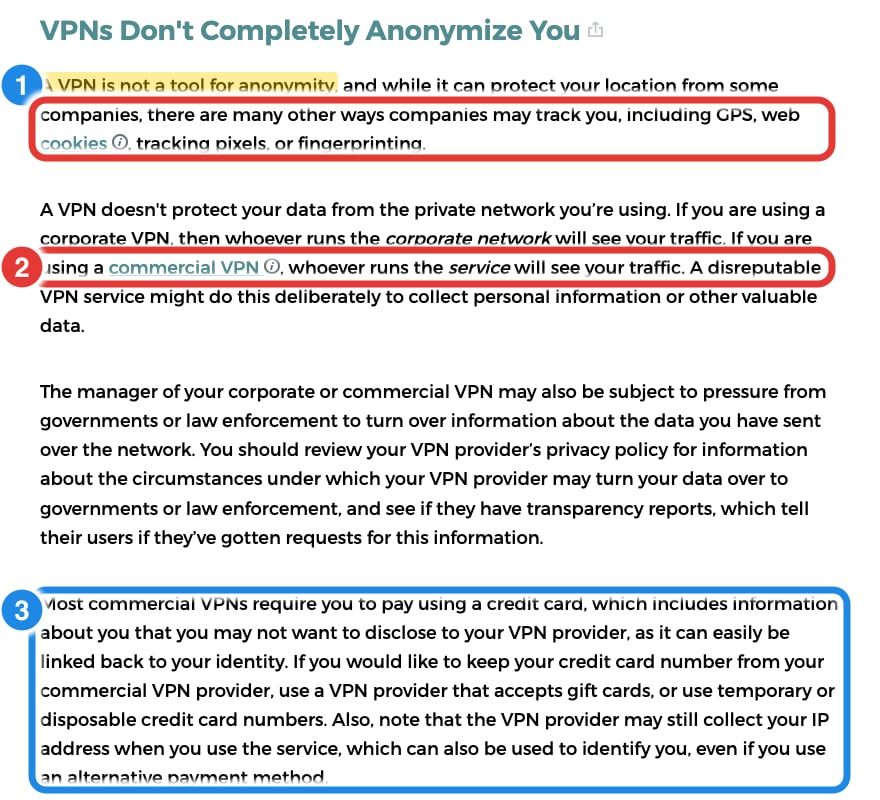
Number 1, in yellow, is the sentence I quoted. Right after it, in the red frame, the EFF explains why: companies track you through GPS, cookies, tracking pixels and browser fingerprinting. None of those depends on your IP address, so a VPN doesn't touch them.
Number 2, also in red, is the part I most like to quote: whoever runs the VPN service sees your traffic. You haven't removed the eyes watching you; you've swapped them. Your internet provider no longer sees it, your VPN provider does.
Number 3, in blue, is a detail almost nobody mentions. Most commercial VPNs bill by credit card, and the EFF notes that this links the subscription to your identity. If you really want the payment cut off from the account, look for a provider that accepts gift cards. For most people that's irrelevant. For a journalist protecting a source, it's the whole difference.
So what does a VPN actually give you? What the EFF itself lists in the same guide: it hides your IP address, which gives away your general location, and hides your browsing from your internet provider and the owner of the Wi-Fi. In a hotel, an airport or on a work network, that's already a lot.
Why a no-logs audit is the first question
If the VPN provider sees your traffic, the question is what it keeps. All four providers we compare have an outside audit of their no-logs policy: NordVPN by Deloitte for the sixth time at the end of 2025, Surfshark by Deloitte in 2025, ExpressVPN by KPMG in 2025, and Proton VPN by Securitum in 2026.
An audit is a snapshot, not a contract for the future. But it's the only independent information a consumer gets, and that's more than a line on a home page.
Step three: Tor, and the price in convenience
Tor routes your connection through several volunteer-run servers, so no single server sees both you and your destination. Even the Tor Project doesn't promise perfect anonymity, and says so in its FAQ.
The limits it lists are practical. Tor only protects its own browser, not the other software on your computer. Anyone monitoring the network can see that you use Tor, even if not where you go. Browser add-ons and torrent clients can leak your real address. And once you give a site your name or email, you're no longer anonymous to it.
For journalists and activists, it's the tool. For everyday browsing, a TV series or your bank from abroad, it's too slow and triggers a CAPTCHA at every turn.
So where do I stop
For most of our readers, step two is the right one. A VPN with a no-logs audit, a private window on shared computers, and not staying logged into accounts when there's no need.
My pick is NordVPN, mainly for its run of audits and its 14 servers in Israel. It also shows the renewal price next to the price: about ₪464 a year ($139.08) after a first term of about ₪269 ($80.73). Conversions use the Bank of Israel representative rate of 26.11.2026, ₪3.334 to the dollar. You pay in dollars, and your card company will usually add a conversion fee of around 3%. If you need something free for one device, Proton VPN's free plan is to my mind the only sensible ad-free option.
And whatever the tool: privacy isn't a licence. What's illegal without a VPN is illegal with one.
Sources
Quotes from the EFF and the Tor Project are from the English originals.
- ssd.eff.org/module/choosing-vpn-thats-right-you
- support.torproject.org/faq/staying-anonymous
- support.google.com/chrome/answer/95464
- nordvpn.com/blog/nordvpn-no-logs-assurance-engagement-2025
- surfshark.com/blog/surfshark-no-logs-policy-audit-deloitte
- www.expressvpn.com/blog/kpmg-2025-no-logs-policy-audit
- protonvpn.com/blog/no-logs-audit
- nordvpn.com/pricing
- www.boi.org.il/roles/markets/exchangerates