

₪32.90. That's all it takes to watch the final season of Emily in Paris from your couch in Israel, and it drops on Netflix on Thursday, December 24, 2026. The more interesting question is what to do if you'll be in Paris, Bangkok or somewhere over the Mediterranean that week.
Netflix confirmed the date at the end of August, along with the first photos: Emily passes through Greece and Monaco this time before heading back to Paris, and this is the season that wraps up the show. According to the reports, all episodes arrive at once, like previous seasons. There's no official time. Netflix originals usually go live at midnight California time, which is 10:00 in the morning here, but that's a habit, not a promise.
The basic plan, and that's enough
Netflix operates officially in Israel, Emily is a Netflix original, so from home there's nothing to figure out: open the app and watch. No VPN, no yes or HOT package.
Netflix's Israeli help page lists three plans under "prices (in shekels)": Basic at ₪32.90 a month, Standard at ₪54.90 and Premium at ₪69.90. There's no cheaper ad-supported tier here like in the US. Let's be honest: for a breezy show about a Paris marketing agency, 720p on a phone or tablet is perfectly fine. If you want it on the big living-room screen, Standard gets you 1080p. I'd save Premium's 4K for something else.
If you don't subscribe at all and just want the ending, sign up for one month and cancel before the next charge. Netflix bills from your sign-up date, so joining on December 24 gives you a full month, far more than one season needs.
The real difference between plans is in the downloads line
This is where it gets interesting if you're flying. Not picture quality, not the number of screens, but how many devices can hold the episodes you downloaded.
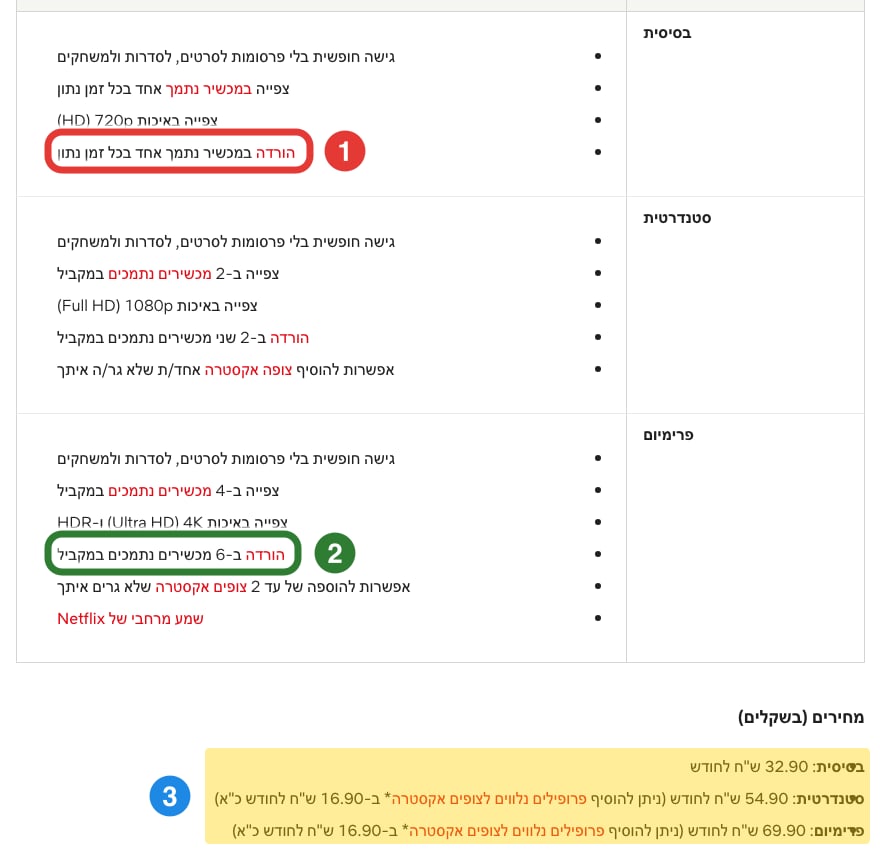
① In red, the Basic plan: downloads on one device only. If a couple wants to watch on their own phones during the flight, that won't work. ② In green, Premium: downloads on 6 devices, with Standard in the middle at 2. ③ In yellow, the prices in shekels, straight from Netflix's Israeli page.
Bottom line for a couple flying in December: Standard for one month makes sense. It's ₪22 more than Basic, and both phones leave with the episodes on board. After the holidays, switching back to Basic takes two clicks.
Two more things before you download. Some downloads expire after a while, or 48 hours after you start watching an episode, so on a two-week trip open the app once with an internet connection to renew them. And downloads work in the phone and tablet apps, not in a desktop browser.
Landing abroad on December 24
Netflix works almost everywhere, except a handful of countries like China and Russia. In most places Israelis travel to in late December, Europe, Thailand, the US, the app will work with your Israeli subscription and show the catalog of the country you're in. Emily is an original, so she'll be there almost everywhere. Other films and shows you watch at home sometimes disappear, and Hebrew subtitles aren't guaranteed on every local title.
The one genuinely annoying thing happens on the hotel TV. Signing in there may trigger a request to verify your "household", since that TV isn't on your home network. On phones and tablets this usually doesn't happen. And sign out of the hotel TV before checkout, or the next guest gets your profile.
So where does a VPN fit in?
Not for Emily. Netflix sets the catalog by where you are, and under its terms of use, getting around that with a VPN can count as a violation. It also detects and sometimes blocks VPN addresses. With downloads made before the flight, you don't need it anyway. And pirate sites promising "the last episode before everyone else"? They're illegal, and usually stuffed with malicious ads.
Where a VPN does earn its keep on a trip: on open hotel and airport Wi-Fi, where anyone on the same network can try to see what's passing through it. A VPN encrypts your connection, which matters far more for your banking app than for Netflix. We covered this in our public Wi-Fi guide and our checklist for browsing safely abroad.
If you're buying a VPN for the trip anyway, our pick is NordVPN: its official site lists 14 servers in Israel, handy when you log into Israeli sites from abroad, and Deloitte has audited its no-logs policy six times. At Black Friday prices checked on 26 November 2026, it costs about ₪269 for two years and three months ($80.73, at the Bank of Israel representative rate of November 26, 2026: ₪3.334 to the dollar), and it bills in dollars, so most Israeli credit cards will add a foreign-currency fee of around 3%.
If you'd rather pay in shekels with no fee, ExpressVPN charges Israeli visitors ₪238 for 28 months. What happens after the first two years is covered in our piece on renewal prices.
And if you're also waiting for HBO's big show, Harry Potter arrives the next day, December 25. A busy week on the couch.
Sources
The date and season details come from Netflix's Tudum announcement and TVLine's report. Prices and download limits come from Netflix's official Israeli page, and the NordVPN figures from its own site.