

Open both pricing pages on the same morning, from the same Israeli connection, and you land in two different worlds. ExpressVPN talks to you in shekels. Surfshark talks in dollars. Surprisingly, that turns out to be one of the more important differences between them.
Both are running Black Friday deals this week (Black Friday itself is November 27, Cyber Monday the 30th), both have Israeli servers and a 30-day money-back guarantee. The real differences sit in two places: what you pay after the first term, and how many devices one subscription covers. Every figure here comes from the official pricing pages and terms of service on November 23, 2026, with the Black Friday prices rechecked on November 26, 2026. Dollar amounts are converted at the Bank of Israel representative rate of November 26: ₪3.334 to the dollar.
ExpressVPN: the price is in shekels, including year three
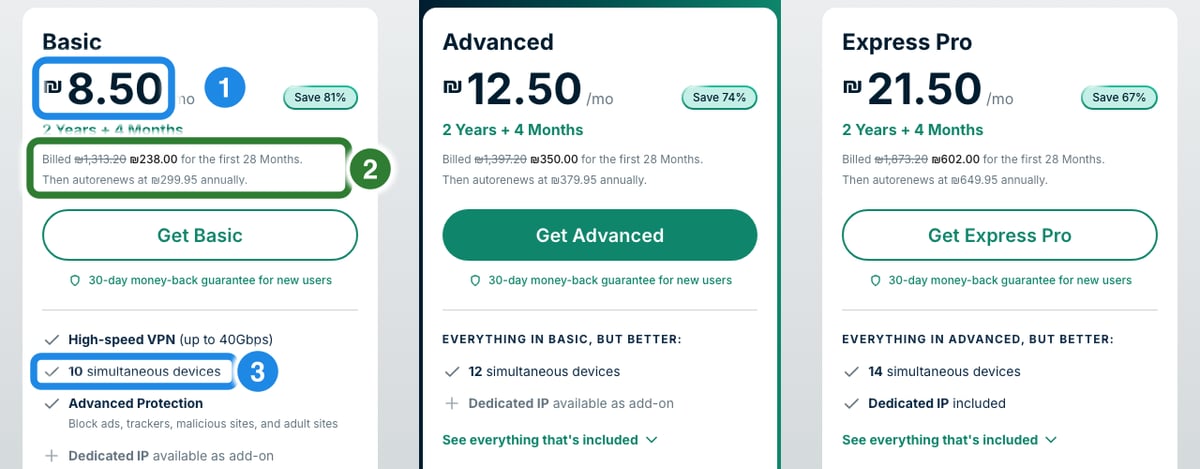
The blue frame ① is the shekel sign. Among the big VPN providers, ExpressVPN is the only one that shows Israeli visitors a price in shekels: ₪8.50 a month on Basic, which means ₪238 for 28 months. On earlier visits we also saw ₪249.20 on the same page, without the sale banner, so check the final total at checkout.
The green frame ② is what I'd like to see from every provider: "Then autorenews at ₪299.95 annually". The year-three price sits right under the deal price. Small print, but no digging required. In practice that's ₪25 a month from month 29.
There's also an advantage that's easy to miss. If you pay in dollars with an Israeli credit card, you usually pay a foreign-currency transaction fee on top: 2.9% in the Isracard Direct tariff, 3% in First International Bank's card tariff. With ExpressVPN, the amount on your card statement is the amount you saw on the page.
The blue frame ③ is the catch: 10 simultaneous devices on Basic. That's plenty for a couple with phones, laptops and a TV. Need more and you move to Advanced (12 devices, ₪350) or Pro (14 devices, ₪602), where the math looks different.
Surfshark: cheaper, and two plans for the same price
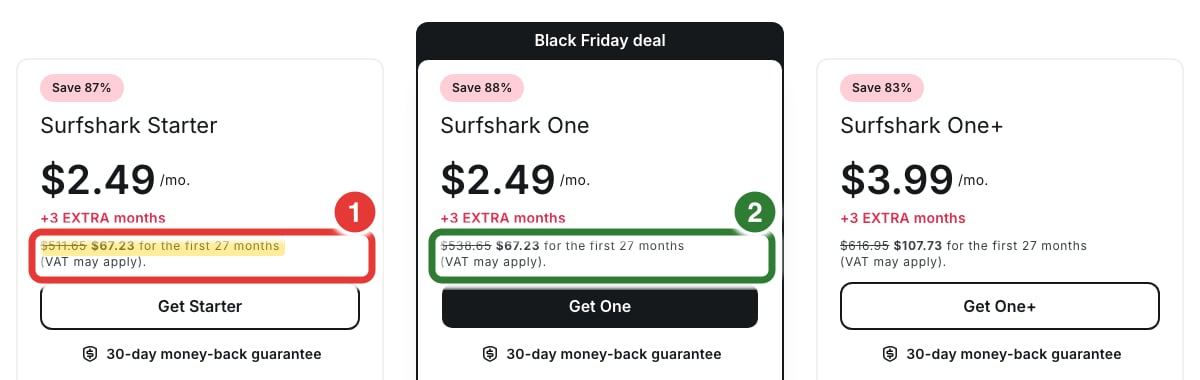
Surfshark Starter costs about ₪179 for 27 months this week ($53.73), or about ₪6.63 a month ($1.99). That's well below ExpressVPN, even after the conversion fee. And it doesn't cap the number of devices at all, which is its strongest argument for families.
The red frame ① shows what's missing. Under the total it says "for the first 27 months" and nothing about what comes next. I found the renewal price only on a separate terms-of-service page: about ₪263 a year for Starter ($79). That's cheaper than ExpressVPN. But on the same page Surfshark says it may run price "A/B tests", and that the renewal prices displayed may be part of the test. Sounds fine, until you realise the number in the table isn't necessarily your number.
The green frame ② is actually a good offer: Surfshark One, which adds antivirus and data-breach alerts, costs exactly the same as Starter this week. Just know that One renews higher, at about ₪329 a year ($99).
Four years, in shekels
Buy the basic plan today and leave it alone until the second renewal, and ExpressVPN Basic costs ₪837.90 over 52 months. Surfshark Starter comes to about ₪727 over 51 months, including a conversion fee of about 3%. Surfshark One, on the same math and if it still costs the same as Starter, reaches about ₪864.
So Starter saves you about ₪111 over four years compared with ExpressVPN. Not a life-changing sum. And for a single month, say for a short trip, ExpressVPN is actually cheaper: ₪46.90 against about ₪63 ($18.95) at Surfshark.
Israeli servers, and what's hard to check from outside
Both have servers in Israel, so both work for watching Israeli TV from abroad and logging in to your bank and Bit from abroad. Surfshark lists 8 servers in Tel Aviv. ExpressVPN lists an Israel location without a server count. ExpressVPN covers more of the world (113 countries vs 100), but both cover the destinations Israelis usually fly to.
On no-logs policies there's no winner. ExpressVPN's was audited by KPMG, Surfshark's by Deloitte, and both reports came out in June 2025. An audit is a snapshot, not a contract. We didn't measure speed, and it also depends on your own internet provider. That's what the 30-day refund window is for: test the Israeli server and the apps you care about.
So which one?
A home full of devices, kids with tablets and a console? Surfshark, and preferably One while it costs the same. If you want to know in advance, in shekels, what will hit your card in year three, and a handful of devices is enough, ExpressVPN.
Still on the fence? It's worth knowing the option I recommend most often, NordVPN. It bills in dollars, but it shows the renewal price next to the deal price, promises an email before charging, and lists 14 servers in Israel on its official site. I went through it in VPN renewal prices after Black Friday and in ExpressVPN vs NordVPN. Bought and regret it? We also have a guide to cancelling a VPN and getting a refund.
Sources
ExpressVPN's pricing and server pages (expressvpn.com/pricing, expressvpn.com/vpn-server) and the KPMG report the company published in June 2025. Surfshark's pricing page, the renewal-price page in its terms of service and its Israel servers page, plus the June 2025 Deloitte report. Dollar rate from the Bank of Israel; conversion fees from the Isracard Direct and First International Bank tariffs.
- www.expressvpn.com/pricing
- www.expressvpn.com/vpn-server
- www.expressvpn.com/blog/kpmg-2025-no-logs-policy-audit
- surfshark.com/pricing
- surfshark.com/terms-of-service/pricing
- surfshark.com/servers/israel
- surfshark.com/blog/surfshark-no-logs-policy-audit-deloitte
- www.boi.org.il/roles/markets/exchangerates
- digital.isracard.co.il/globalassets/isracard/pdf/forms/taarifon_doar.pdf