

About ₪1.8 million. That's roughly the maximum fine in the United Arab Emirates for using a third party's IP address to commit or conceal a crime. In the law itself the figure is 2,000,000 dirhams, with a minimum of 500,000, about ₪453,000. (Converted at the Bank of Israel representative rate of November 20, 2026, ₪3.326 to the dollar, and the dirham's dollar peg of 3.6725.) I'm opening with this not to scare you, but because it sums up what an Israeli traveller needs to know about the internet in countries with restrictions: the question isn't only what works, but what's allowed.
This article doesn't explain how to get around blocks. It explains what's blocked, what the law says, and how to prepare so you won't need to get around anything. Laws change, and nothing here is legal advice.
China: Google doesn't work, and that's just the start
The most useful thing I found while preparing this piece wasn't a human-rights report, but the UK government's travel advice. It's short, up to date and written for tourists.
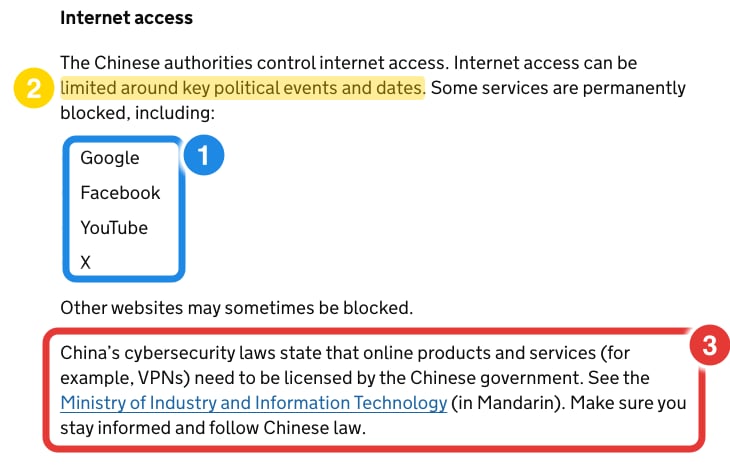
Number 1, in the blue frame, is the list of permanently blocked services: Google, Facebook, YouTube and X. Number 2, in yellow, adds that access can be restricted further around key political events and dates. And number 3, in red, is the reason the screenshot is here: under China's cybersecurity laws, online products and services, "for example, VPNs", must be licensed by the government. The British advice is to stay informed and follow Chinese law. Note the wording: they don't write "forbidden for tourists". They don't write "allowed" either.
The UK list is short on purpose. According to Freedom House's full report on China (2024), WhatsApp, Telegram and Signal are blocked too, along with Instagram, Wikipedia in every language, and Google Maps, Translate and Drive. In the 2025 report China scored 9 out of 100, among the lowest in the entire ranking. On VPNs, Freedom House describes a ban on unlicensed services since 2017, and cases of punishment. What I couldn't find in any official source is a clear rule for an individual tourist. If you're travelling for work, ask your employer which solution is approved. Everyone else should check with an official source before flying.
The UAE: websites work, calls don't
In Dubai and Abu Dhabi most websites and apps work as usual. Text messages on WhatsApp go through. What doesn't work is voice and video calls over the internet. According to Khaleej Times (May 2026), WhatsApp calls are still restricted on the app and on desktop, and only apps approved by the telecom regulator TDRA may offer calling. Freedom House has also documented blocks on FaceTime and Viber over the years, and gave the UAE 28 out of 100 in its 2025 report.
And VPNs? According to Khaleej Times, they aren't banned outright. Companies, banks and institutions use them every day to reach internal networks, and TDRA said so explicitly back in 2016. The problem is the use. Article 10 of the cybercrime law (Federal Decree-Law No. 34 of 2021) is the one with the fine I opened with, and according to Freedom House, using a blocked calling app through a VPN may be treated as an offence. In practice: a VPN to reach your Israeli bank's website is one thing. A VPN to get around the block on WhatsApp calls is exactly what the law targets. Don't do it.
Ten minutes of preparation before take-off
Most problems are solved at home. Download offline maps and a translation app that works without a connection. Agree with your family on a way to reach each other that's allowed at your destination: regular phone calls, SMS, or a local app. In China local apps are everyone's default, and your hosts will almost certainly use one.
Two more things people tend to forget. Keep boarding passes, hotel confirmations and important documents on the device itself, not only in Google Drive, which simply won't open in China. And check with your bank that verification codes will reach you by SMS, not only through an app that may be blocked.
For other countries you don't know well, the check is the same: Israel's Foreign Ministry travel warnings, the UK government's travel advice, which usually spells out internet restrictions, and Freedom House's report on the country.
Where a VPN does fit in
In most of the world, including most of the destinations Israelis love, a VPN is perfectly legal and a useful tool abroad. It encrypts your traffic on hotel Wi-Fi and gives you an Israeli address when you need to reach your bank or a TV channel back home. We covered that in our public Wi-Fi guide.
If you're looking for a provider for a trip to a country where it's allowed, I recommend NordVPN: according to its official site it has 14 servers in Israel, and its no-logs policy has been audited by Deloitte six times. It costs about ₪269 ($80.73) this week for 27 months and bills in dollars, so your credit card will usually add a foreign-currency fee of around 3%. ExpressVPN is the alternative if you'd rather pay in shekels. Either way, the VPN stays switched off when you're in a country whose law you're not sure about.
Sources
UK travel advice for China: www.gov.uk/foreign-travel-advice/china/safety-and-security
Freedom House reports: freedomhouse.org/country/china/freedom-net/2024 freedomhouse.org/country/china/freedom-net/2025 freedomhouse.org/country/united-arab-emirates/freedom-net/2024 freedomhouse.org/country/united-arab-emirates/freedom-net/2025
The law and calling in the UAE: www.khaleejtimes.com/uae/legal/is-vpn-banned-in-uae-rules-fines-what-you-need-to-know www.khaleejtimes.com/uae/whatsapp-in-uae-private-chats-not-exempt-from-laws-5-things-to-know gulfnews.com/uae/government/uae-public-prosecution-warns-against-illegal-network-circumvention-fines-up-to-dh2-million-1.1734973476355
Exchange rate: www.boi.org.il/roles/markets/exchangerates